

"Stay positive until you achieve your final product till an estimated target"

Iris flower classification project
I have included my github project link above and project description at the bottom of the blog . In middle ,I have included flower’s overall points and specifications to know more about the flower species. Have a happy reading throughout !

Iris is a genus of 260–300 species of flowering plants with showy flowers. It takes its name from the Greek word for a rainbow, which is also the name for the Greek goddess of the rainbow, Iris. Some authors state that the name refers to the wide variety of flower colour’s found among the many species. As well as being the scientific name, iris is also widely used as a common name for all Iris species, as well as some belonging to other closely related genera. A common name for some species is ‘flags’, while the plants of the subgenus . Scorpiris are widely known as ‘junos’, particularly in horticulture. It is a popular garden flower.
Scientific classification
| Domain: | Eukaryota | Life |
| (unranked): | Diaphoretickes | Eukaryota |
| (unranked): | Archaeplastida | Diaphoretickes |
| Kingdom: | Plantae | Archaeplastida |
| Clade: | Streptophyta | Plantae |
Distribution and habitat
Nearly all iris species are found in temperate Northern hemisphere zones, from Europe to Asia and across North America. Although diverse in ecology, Iris is predominantly found in dry, semi-desert, or colder rocky mountainous areas. Other habitats include grassy slopes, meadowlands, bogs and riverbanks.
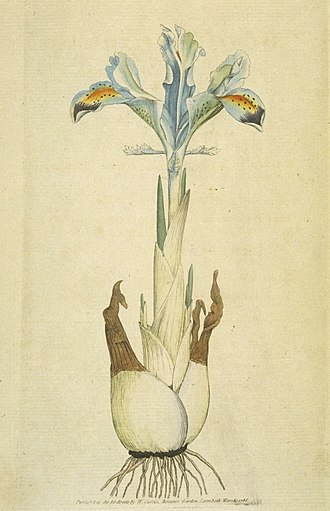
There are around 300 varieties of flowers in the Iris genus. These famous flowers are available in two main forms: those that grow from rhizomes and those that grow from bulbs.
Iris flowers feature unique blooms that are made up of two different kinds of petals, falls and standards. The falls form the lower petals, which droop downward or fall. The standards are the upper three petals of the flower. The characteristics of an iris petal further segment the plant into three types: bearded, crested, and beardless. Bearded iris plants have soft hairs along their falls, resembling a beard. The flowers of a crested iris have a ridge-like crest on their falls.
Irises that grow from bulbs include Iris reticulata, Spanish (Iris xiphium) and Dutch varieties (Iris x hollandica) and bloom earlier than the rhizomatous irises. However, most irises show their famous flowers in the early summer, while some also bloom for a second time in the late summer. They are known for attracting butterflies and hummingbirds and make perfect cutting flowers. The iris varies greatly in size, from the smallest dwarf variety, which only grows to 6 inches tall, to the tallest variety which is up to 4 feet tall.
| Botanical Name | Iris |
| Common Name | Iris |
| Plant Type | Perennial |
| Mature Size | 6 in. to 4 ft. tall |
| Sun Exposure | Full sun |
| Soil Type | Rich, moist, well-draining |
| Soil pH | Neutral to slightly acidic |
| Bloom Time | Late spring, early summer, and late summer |
| Flower Color | Varying shades of purple, blue, white, yellow |
| Hardiness Zones | 3 to 9, USA (depending on variety) |
| Native Area | Europe, Asia, North America |
| Toxicity | Toxic to humans, toxic to pets |
Iris Varieties
- Yellow Iris: Also sometimes known as “flag,” this variety of beardless iris is highly tolerant of moisture. It is an abundant spreader, which sometimes deters gardeners from planting it. However, it makes a great container flower variety and produces beautiful blooms and bright green foliage.
- Louisiana Iris: This iris is native to the U.S. and hardy to zone 6-9. They boast a wide variety of colors and petals that are reminiscent of lilies.
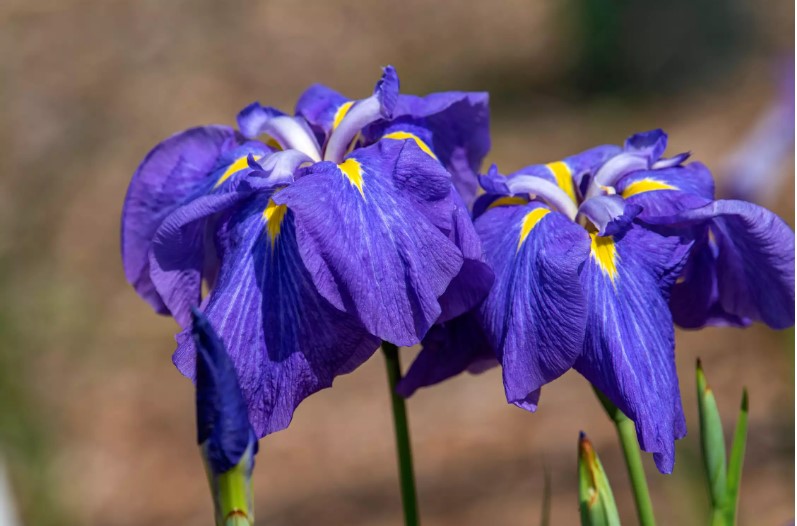
- Japanese Iris: The Japanese iris boasts large, broad petals, and a stunning array of colors. This variety also does well with increased soil moisture, making it the perfect choice in areas with high water tables or a greater chance of standing water.
- Siberian Iris: The Siberian iris provides smaller, more delicate-looking blooms than many other iris species and adds a beautiful pop of colour in the late spring.
Propagating Irises
Irises spread underground through rhizomes or bulbs and will need to be divided every 3 to 5 years, creating the perfect opportunity to spread your irises to new landscaping areas. You will know when it is time to divide when you have fewer blooms or there are rhizomes popping out of the ground. Follow these basic steps to propagate iris plants:
- Wait for 6 to 8 weeks after your irises have finished blooming. Then, with a garden fork or shovel, slowly work around each plant to loosen the rhizomes or bulbs.
- Gently lift the iris out of the ground and shake out the dirt.
- Once the dirt is removed you will be able to see the rhizomes or bulbs. You will find smaller rhizomes spreading from the larger mother rhizome. Some may come away naturally while others will need to be cut. Either way, divide these smaller rhizomes and toss any old, shriveled rhizomes.
- Once you divide the rhizomes and remove any that are spent or diseased, simply plant the divided iris plants in a new location.
Iris flower classification project using Machine Learning
First of all , What is Machine Learning ?
Machine learning is a form of artificial intelligence (AI) that aims to build systems that can learn from the processed data or use data to perform better.
Machine learning algorithms build a model based on sample data, known as “training data”, in order to make predictions or decisions without being explicitly programmed to do so. Machine learning algorithms are used in a wide variety of applications, such as in medicine, email filtering, speech recognition, and computer vision, where it is difficult or unfeasible to develop conventional algorithms to perform the needed tasks.
Now , let’s take a dig at this project!
Iris flower classification project using machine learning
Libraries used in this project : Numpy , Pandas , Matplotlib , Sciket-learn(sklearn).
Methods used : Data Cleaning , Data Preprocessing , Logistic Regression , Outlier Detection , Exploratory Data Analysis (EDA), Data Visualization , Data Modelling , Confusion matrix and classification report.
Technologies and tools used : Machine Learning , Google Colaboratory.
Accuracy achieved : 95.64 %
Project completed on : July 21st 2021
 Monologue Forum